Superposition Hardware (H gate)
Here we explore how a single photon passes through a directional coupler and collapses to one output upon measurement.
DC Coupler: Photon Superposition
Figure A: A single photon enters a DC coupler, creating a superposition state. Upon measurement, it randomly collapses to either the top or bottom path.
Ready to run - Photon will enter coupler and randomly emerge from top or bottom path
What is a DC Coupler?
A DC (Directional Coupler) is an optical device that splits a single photon into a quantum superposition of two paths.
- When a single photon enters the coupler, it enters a superposition state of being in both paths simultaneously
- Upon measurement, the photon's wave function collapses to one path with 50% probability each
- This demonstrates the quantum principle that a particle can be in multiple states at once until observed
Quantum Photonic Chip
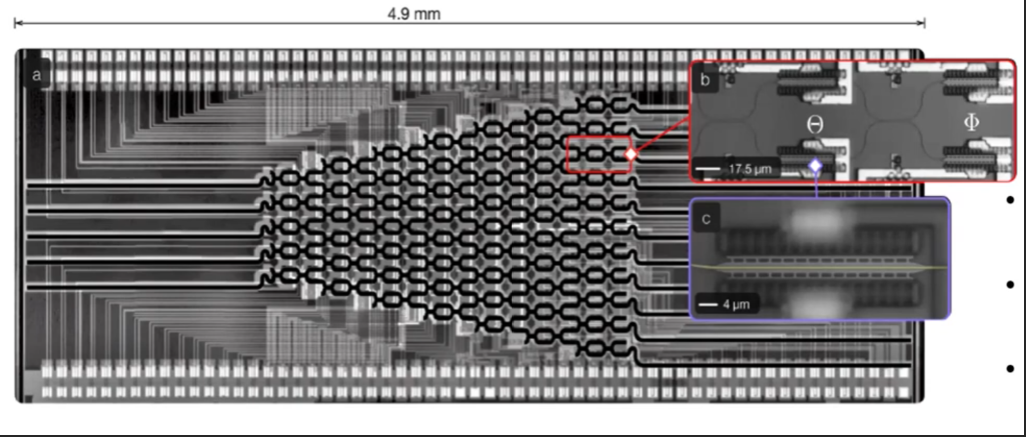
This image shows a real quantum photonic chip where DC couplers like the one simulated above are fabricated. The intricate patterns you see are optical waveguides etched into silicon, creating pathways for photons to travel and interact. These chips enable quantum computing operations by manipulating individual photons through precisely engineered optical components.